
Miller County Scheduled vs Actual
A projected date is a planning date derived from a sentence, credits, parole rules, and the record then known. The actual release date is when the person legally leaves that authority's custody. They can differ. A pretrial detainee at Miller County Jail has no sentence-based date. Bond, a first appearance, a dismissal, a later court order, a hold, or transfer controls the next step.
A sentenced person may have an MRD, or Maximum Release Date, while a parole-eligible state prisoner may also have a TPM, or Tentative Parole Month. Neither term alone proves the person will walk out on a certain day.
Find Miller County Release Timing
Begin with custody, not a date calculator. Miller County Jail, GDC, the federal Bureau of Prisons, and immigration custody use different records. The broader Miller County released inmate search can help identify the correct system.
- Ask whether the person is at Miller County Jail, in GDC, or in another authority's custody.
- For the jail, call (229) 758-3421 and ask about bond, a release order, holds, and transfer status.
- Check bond and first-appearance action through Magistrate Court.
- Check a final criminal disposition or sentence through the Clerk of Court.
- For GDC, use Find an Offender and record the GDC ID, status, and visible sentence dates.
- If parole applies, check the Board's TPM lookup and confirm any final date with GDC or the Board.
Georgia TPM MRD and PIC
The Georgia Board's TPM explanation defines a Tentative Parole Month as the month for final review, not a final parole decision. Good conduct and required programs can remain conditions. Misconduct can postpone or cancel the plan. The Board may also reconsider before release.
GDC's Performance Incentive Credit program lets eligible offenders earn points through approved education, work, treatment, and conduct. Up to 12 points can mean one to twelve months off a TPM or MRD. Exclusions include short sentences, life sentences, death sentences, and listed mandatory or non-parole-eligible cases. PIC is not a universal credit.
The public TPM application accepts a six-digit inmate number, GDC ID, or personal data. A match must still be checked against the person's identity and current GDC status.
The official PIC page shown below ties eligible progress to a TPM or maximum release date.
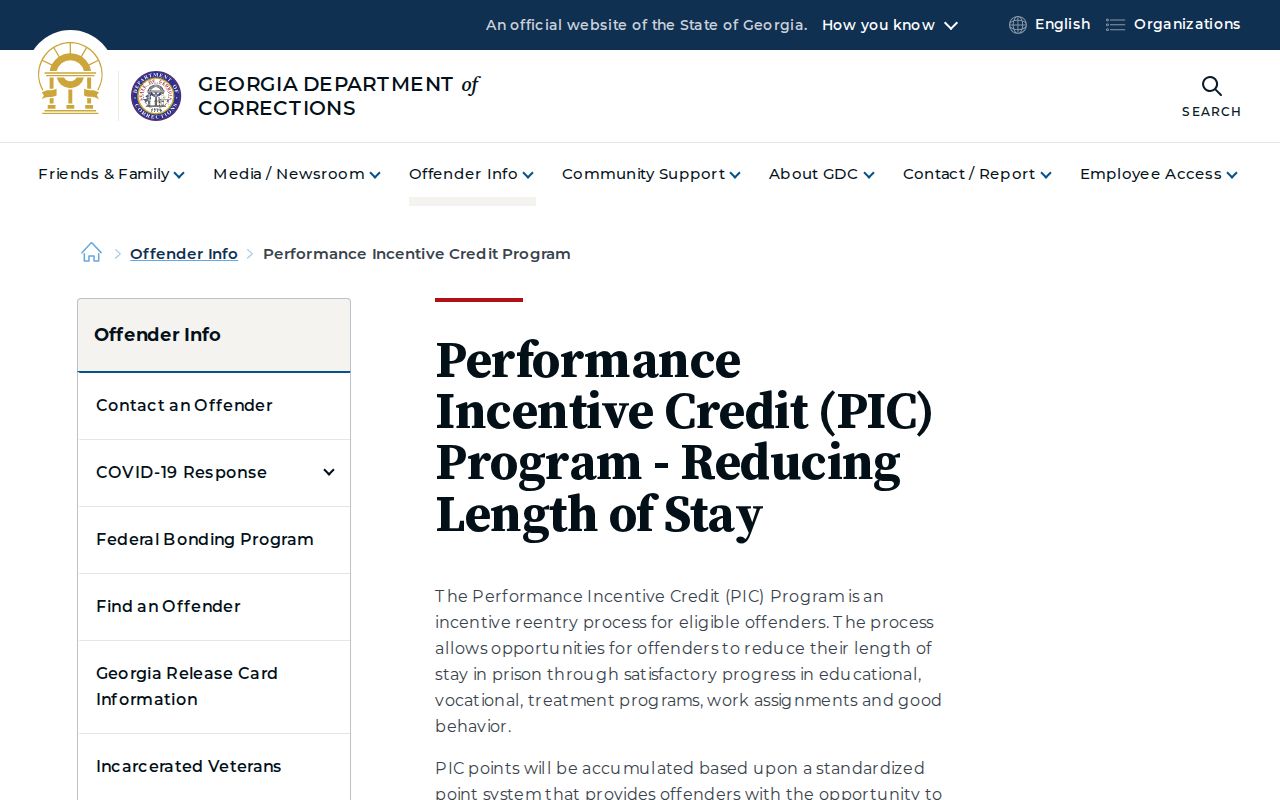
That state rule applies to eligible GDC cases, not to a locally invented Miller County jail formula.
Why Miller County Dates Change
A date moves when the legal or custody facts change. Some events alter the sentence calculation. Others do not change the sentence but prevent release to the community.
| Factor | Possible effect |
|---|---|
| Bond or court order | Can authorize a local jail release or change the expected timing. |
| Discipline or unmet program term | Can reduce credit or postpone a tentative parole plan. |
| PIC award | May reduce an eligible GDC TPM or MRD by the approved amount. |
| Detainer or hold | May cause transfer or continued custody after the first case ends. |
| Parole decision | May set, deny, postpone, cancel, or later revise a tentative month. |
| Sentence correction | A court or records correction can change the controlling dates. |
Confirm Miller County Release Dates
Use VINE Inmate Check as a notice tool when the relevant agency participates, then verify the reported event at its source. For jail custody, ask the sheriff whether the person left for the community or was transferred. For state custody, compare GDC status, the TPM tool, and Board records. A parole begin date after release is different from a prior TPM.
Federal dates belong in the BOP locator, which warns that First Step Act recalculations can change displayed dates. No single Miller County page combines all of these authorities.
No Georgia 85 Percent Shortcut
Georgia research does not support a blanket rule that every person serves 85 percent. Sentence-specific mandatory minimums, parole eligibility, serious violent felony restrictions, Board review, PIC, and MRD all matter. Most parole-eligible felony inmates are automatically considered and are often eligible after one-third of the sentence, but eligibility is not a promise of release.
Specified serious violent felony cases committed on or after January 1, 1995 may be ineligible for parole. Life-sentence eligibility can depend on offense date, including seven-year, fourteen-year, or thirty-year frameworks described by the Board. Relevant statutes include O.C.G.A. § 17-10-6.1 and O.C.G.A. § 42-9-45. Use the sentence and offense facts, not a slogan.
Miller County Custody Stage Matters
The official Miller County jail description explains why custody stage must come before date math. The jail holds people awaiting court, people serving some misdemeanor sentences, and sentenced people awaiting transfer to state or federal custody. A date given during the local jail phase may refer to a hearing, bond eligibility, sentence end, or transfer. Those are not the same event.
For a person awaiting court, ask which court controls the case and whether bond has been set or satisfied. For a local sentence, ask the jail and court how the judgment is being applied. No public Miller County jail good-time policy or release calculator was found, so no local credit rate should be assumed. For a sentenced person awaiting GDC pickup, use the court commitment and jail transfer status until GDC receives and classifies the person.
The GDC custody process describes movement from local jail to diagnostic processing, an assigned institution, reentry, and release. The official process image below helps distinguish transfer into state custody from release to the community.
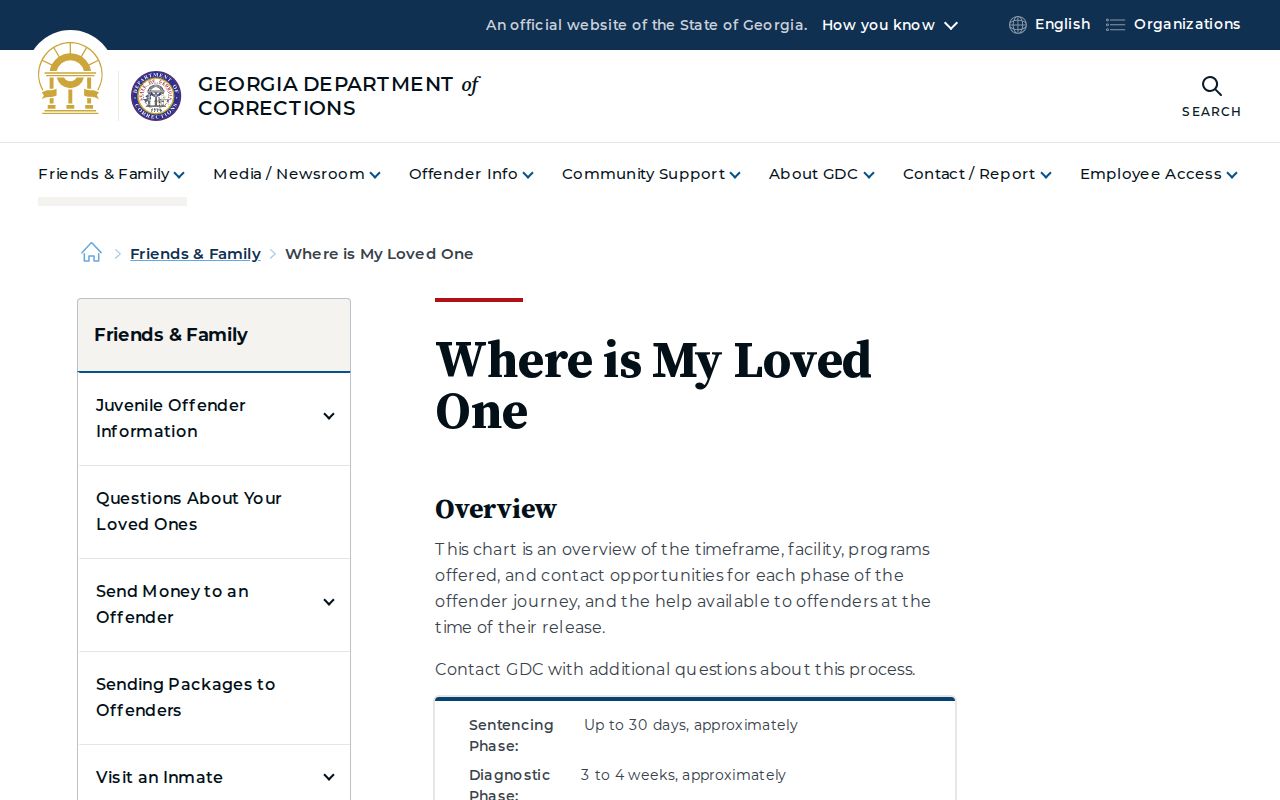
Once GDC takes custody, state identifiers and state date concepts replace the local jail's transfer estimate.
Miller County Parole Date Review
Parole eligibility means the Board may consider release before the maximum sentence ends. It does not create an enforceable release day. The Board can set a TPM, deny parole, or reconsider a prior action before release. Conditions may include good conduct, work release, or program completion.
The Georgia parole process is the source for these distinctions.
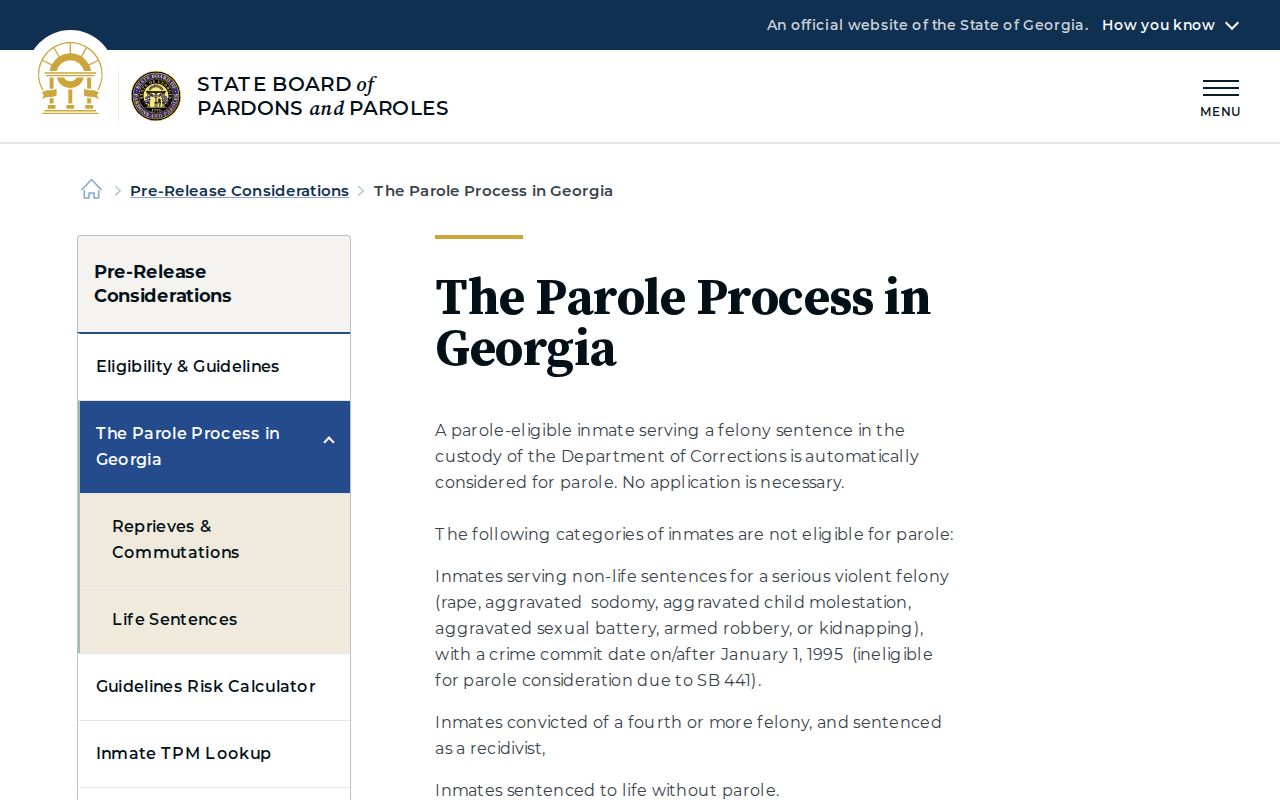
Read the Board result alongside the GDC sentence record. After release, use the parolee database and Donalsonville DCS for supervision status rather than treating an old TPM as current proof.
Miller County Release Date Terms
Several dates may appear in the same state case, and each answers a different question. Parole eligibility is the first point at which an eligible person can be considered. A TPM is a later Board planning month if one is set. An MRD reflects the maximum release calculation then in the state record. A parole begin date records when supervision started after release. A sentence-completion date may reflect discharge without Board supervision.
- TPM
- Tentative Parole Month, subject to final Board review and conditions.
- MRD
- Maximum Release Date in the GDC sentence calculation.
- PIC
- Performance Incentive Credit that can reduce an eligible TPM or MRD.
- Detainer
- A request or legal hold from another authority that may prevent community release.
- Discharge
- The end of the sentence or supervision obligation recorded by the responsible agency.
Write down the label exactly as shown. Calling every date a projected release date can create false certainty. If two sources conflict, use the agency responsible for that stage and request a record correction or explanation. The jail can explain local custody. The court controls its orders. GDC maintains the state incarceration record, and the Board controls parole decisions.
How TPM MRD and PIC Interact
A Miller County state-prison case can carry more than one release measure. The MRD is the maximum date in the sentence calculation. A TPM reflects the Board's tentative parole planning. PIC can reduce an eligible TPM or MRD through approved progress, but it cannot create parole eligibility where the sentence or offense rules bar it. This interaction is why a fixed percentage produces the wrong answer.
Start with the judgment and GDC record. Identify the sentence, offense date, parole eligibility, and any mandatory minimum. Next, check whether the Board has set a TPM. Then ask whether PIC eligibility and earned points affect that TPM or MRD. Finally, confirm whether conduct, program completion, a court change, or another hold has altered the result. Each step uses a different source.
The Board describes a TPM as conditional. Final review still must occur. A program or work-release requirement may remain, and misconduct can lead to postponement or cancellation. GDC describes PIC as an incentive for eligible progress, not a guaranteed award. A person excluded by sentence type cannot use PIC to bypass that exclusion.
Local and State Date Sources
Miller County Jail cannot set a Georgia parole date, and the Board does not control a local bond order. The office responsible for each event should answer that part of the timeline. Call the jail for current custody, local sentence application, release processing, and transfer status. Use Magistrate Court for first appearance and bond. Use Superior Court and the clerk for the judgment, felony disposition, and later sentence orders.
After GDC receives the person, use the GDC identifier to follow the state record. The offender search can establish current state status and visible sentence data. The TPM application handles tentative parole timing. The Board's prison-release and parolee tools help after release, while Donalsonville DCS serves Miller County supervision. These tools complement one another; none replaces the underlying judgment.
When dates conflict, write down the label, source, and retrieval date for each one. Ask whether one is eligibility, one is tentative parole, and one is the maximum sentence calculation. A later court order or records correction may explain the difference. If not, request confirmation from GDC Inmate Records and Information at P.O. Box 1529, Forsyth, GA 31029, or from the Board for a parole decision.